

If you are planning your next move to Dubai, or wondering whether there will still be good jobs here in two or three years, this is the news to pay attention to.
On 14 October 2026, Sheikh Mohammed bin Rashid Al Maktoum laid out a pipeline of active projects in Dubai worth AED 2.1 trillion (about USD 572 billion), speaking at the Mohammed bin Rashid Leadership Forum. New homes, a giant airport, more metro lines, new aircraft, bigger power and water networks – all of it needs people to build it, run it and serve the people who will use it.
Here is what is being built, the upcoming jobs in Dubai it is likely to create, and what you can do now to be ready.
Dubai’s AED 2.1 Trillion Project Pipeline at a Glance
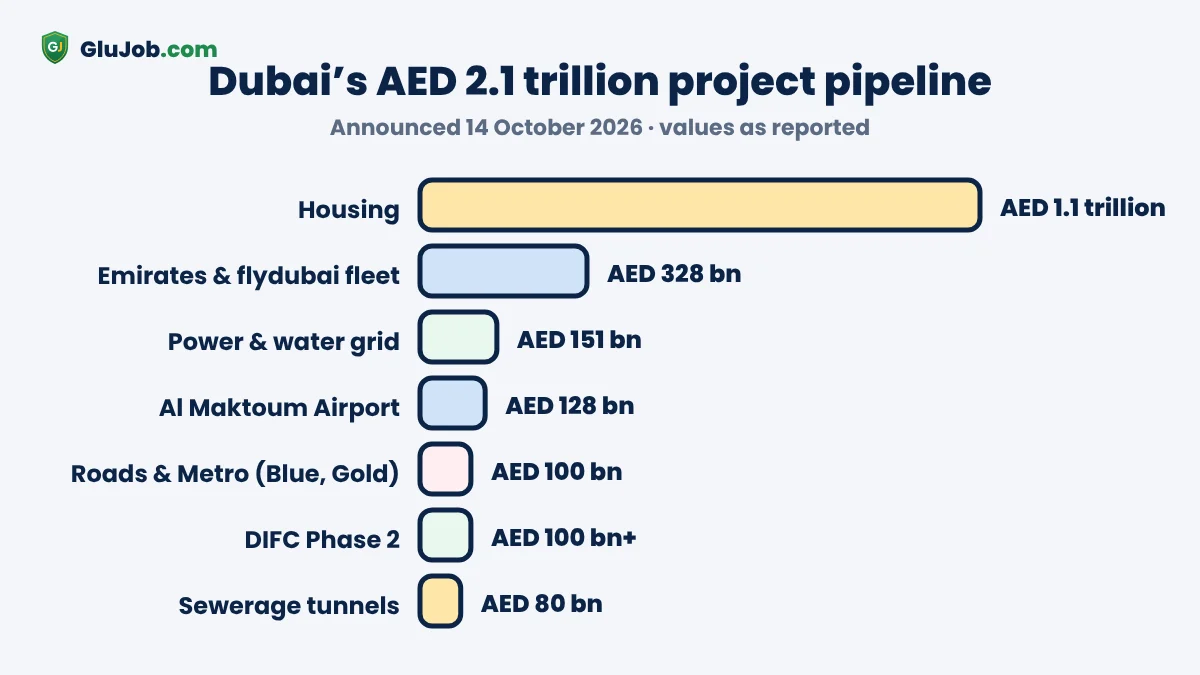
| Project area | Value (as announced) | What it includes |
| Housing | AED 1.1 trillion | About 350,000 new homes through 2030 |
| Airlines | AED 328 billion | Emirates and flydubai fleet expansion |
| Power and water | AED 151 billion | Electricity and water grid upgrades |
| Al Maktoum International Airport | AED 128 billion | Built for up to 260 million passengers a year over the next decade |
| Roads and Metro | AED 100 billion | Road upgrades plus the Dubai Metro Blue and Gold lines |
| DIFC Phase 2 | Over AED 100 billion | Expansion of Dubai’s financial centre |
| Sewerage tunnels | AED 80 billion | Dubai Strategic Sewerage Tunnels |
| Tasreef drainage | AED 30 billion | Rainwater drainage network |
| Emirates engineering | AED 18.7 billion | New aircraft engineering and maintenance complex |
These are the figures as reported from the announcement. Many of these projects run for years, so hiring will come in waves, not all at once.
Upcoming Jobs in Dubai: What This Plan Will Create
Big projects don’t only hire engineers. Every stage – design, building, opening and running – needs a different set of workers. Here is how it breaks down.
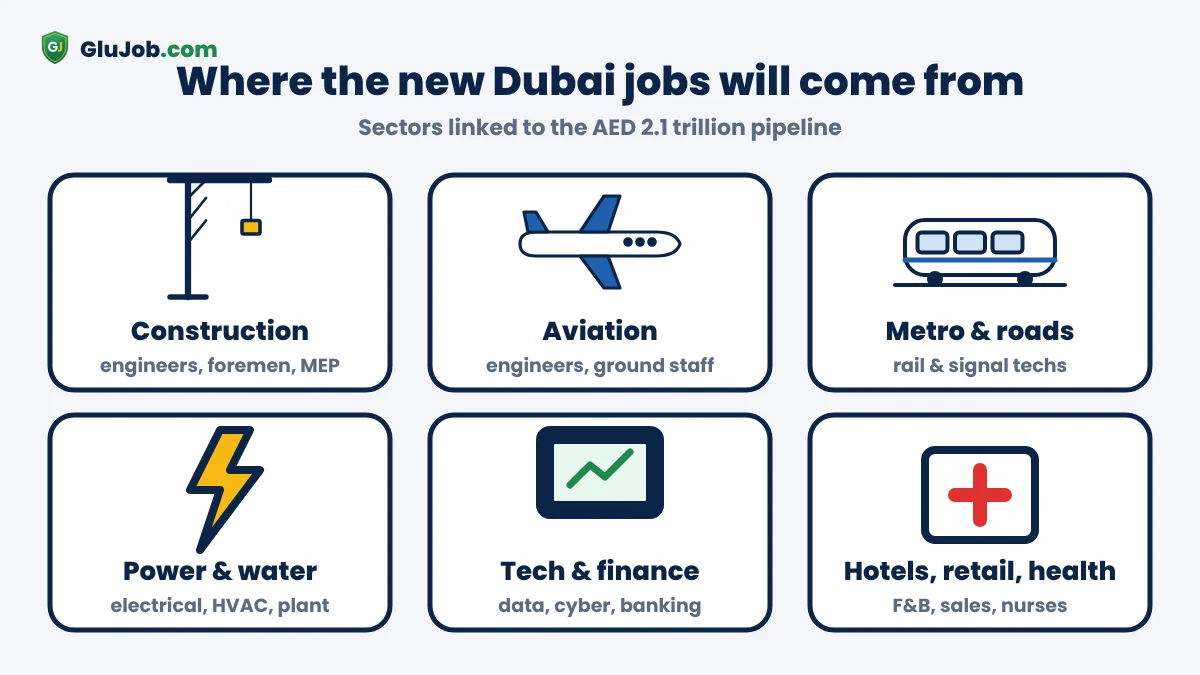
1. Construction and Real Estate
350,000 homes, metro lines, tunnels and an airport mean steady demand for civil engineers, project managers, quantity surveyors, site supervisors, safety officers, foremen, steel fixers, masons, electricians, plumbers and heavy equipment operators. Once buildings are handed over, facilities management companies need technicians, cleaners and security staff to run them.
2. Aviation and Airports
A new mega-airport plus a bigger Emirates and flydubai fleet is one of the clearest job signals for the next ten years. Think aircraft maintenance engineers and technicians, ground handling staff, customer service agents, cabin crew, cargo and logistics staff, airport security and drivers. The planned Emirates engineering complex alone will need large teams of licensed engineers and mechanics.
3. Metro, Roads and Transport
The Blue and Gold metro lines will need rail engineers, signalling and systems technicians, station staff and maintenance crews. Road upgrades keep demand going for surveyors, traffic engineers and equipment operators.
4. Power, Water and Infrastructure
Grid upgrades, sewerage tunnels and drainage are long, technical projects. They hire electrical and mechanical engineers, tunnelling specialists, MEP technicians, HVAC technicians and plant operators.
5. Technology, Finance and Data
DIFC’s expansion and the wider digital push mean more roles in banking, compliance, data, cybersecurity and data centres. Recruiters quoted by Gulf News name data centre managers as a priority role.
6. Hospitality, Retail and Services
More homes and more passengers mean more hotels, restaurants, malls and services. Recruiters expect steady hiring in F&B, retail, FMCG, customer service and marketing, and healthcare keeps growing alongside the population.
Skills Employers Will Want
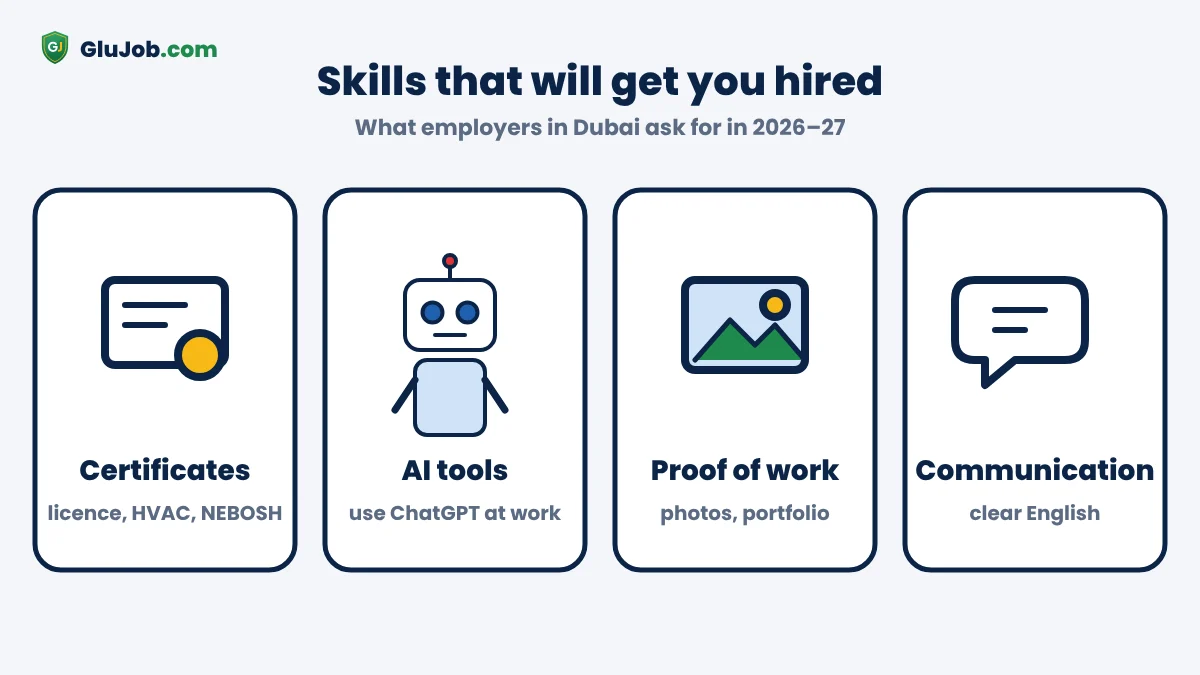
- Recognised certificates for technical trades – a UAE driving licence, HVAC or electrical certification, NEBOSH or IOSH for safety roles.
- Basic AI and digital skills. Recruiters say employers now want people who know how AI tools apply to their own work, even outside IT.
- Proof of your work. Photos of projects you worked on, a simple portfolio or a short case study often beat a long CV.
- Communication. Clear English and the ability to work with people from many countries still matter in every sector.
When Will the Jobs Come?
Not overnight. Housing plans run through 2030 and the airport target covers the next decade. Construction roles usually come first, then operations and service roles as each project opens. Recruiters quoted by Gulf News expect hiring to continue into 2027, but employers will stay selective – so a well-prepared CV matters more than ever.
What You Can Do Now
- Pick your sector. Match your experience to one of the six areas above.
- Upgrade one skill. A licence, a safety course or a short AI course can make you stand out.
- Update your CV with numbers: projects, team size, results. Our free ATS CV Maker can help.
- Follow real openings. See today’s jobs in Dubai and walk-in interviews in Dubai.
- Never pay for a job. Big projects attract fake recruiters. Check any offer with our Fake Job Checker.
Frequently Asked Questions
How big is Dubai’s new project pipeline?
About AED 2.1 trillion (USD 572 billion) in active projects, as announced on 14 October 2026.
Which sectors will hire the most in Dubai?
Construction, aviation, infrastructure, technology and finance, plus hospitality, retail and healthcare as new areas open.
Will Al Maktoum Airport create jobs?
Yes. With AED 128 billion planned and capacity for up to 260 million passengers a year, it will need airport, airline, logistics and service staff over the coming decade.
Sources: Announcement by Sheikh Mohammed bin Rashid Al Maktoum at the Mohammed bin Rashid Leadership Forum, 14 October 2026, as reported by Travels Dubai; hiring outlook from recruiters quoted by Gulf News (2026). Figures are as announced and may change. GluJob is a free job information website, not a recruitment agency.